
How to Create a Marathon Medal That Participants Will Keep
To create a marathon medal that participants will keep, design it around your race's unique story—connecting a meaningful concept, quality materials, thoughtful details, and emotional resonance—so that every runner sees their personal achievement reflected in the medal the moment they cross the finish line.
Every year, millions of marathon finishers receive a medal at the finish line. Some of those medals end up displayed on shelves, framed on walls, or carefully stored in memory boxes. Others end up in a drawer, forgotten within weeks.
The difference is almost never the race itself. It's the medal design.
If you're organizing a marathon, half marathon, or running event, the medal you hand to each participant is one of the most powerful touchpoints in their entire experience. It's the physical proof of their achievement. It's the object they'll hold up in their finish-line photo. It's the thing they'll show friends and family for years to come.
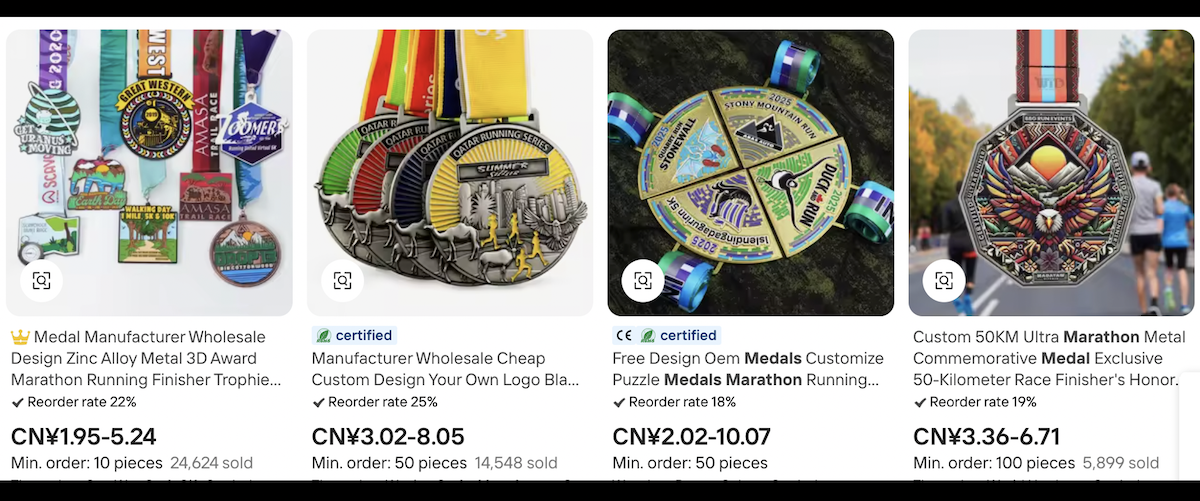
So how do you design a marathon medal that participants genuinely value? This guide walks you through every decision—from concept to production—that separates a forgettable finisher token from a meaningful keepsake.
Why Do Some Marathon Medals Become Keepsakes While Others Get Forgotten?
The answer comes down to three factors: uniqueness, story, and perceived quality.
A generic medal with a running shoe silhouette and the words "Finisher 2025" tells the runner nothing specific about their experience. It could belong to any race, anywhere in the world. There's no emotional anchor.
A medal that captures something specific—a city landmark, a route elevation profile, a race milestone, a charity mission—creates an immediate connection between the object and the memory. When a runner looks at that medal months later, they don't just see metal. They see the moment they crossed the finish line. They remember the crowd, the pain, the pride.
Perceived quality matters too. A custom medal that feels lightweight, thin, or poorly finished signals to the runner that the race organizers didn't invest much thought into the experience. A medal with satisfying weight, clean details, and a premium finish communicates respect for the participant's effort.
Start With the Marathon's Story, Not the Medal Shape
The most common mistake race organizers make is starting the design process by browsing medal catalogs and picking a shape. The right starting point is your race's identity.
Ask yourself: What makes this race different?
Is it the city? The route? A landmark runners pass at mile 20? A charity cause? A historical anniversary? A unique terrain challenge?
Once you identify that story, the design direction becomes clear. A coastal marathon might feature wave patterns and a lighthouse. A mountain trail race might incorporate elevation contours. A city marathon might highlight a skyline or iconic bridge.
Generic running-shoe and runner silhouettes fail because they carry no story. They're the visual equivalent of clip art. When every race uses the same imagery, no race stands out.
Choose a Medal Concept Participants Can Recognize Instantly
The best marathon medal designs communicate their meaning within two seconds. Here are proven concept directions:
- City and landmark-inspired medals – Use a recognizable local landmark as the central element. The Eiffel Tower, the Golden Gate Bridge, a local cathedral—these create instant geographic identity.
- Route and map-inspired medals – The race route itself can become the design. Elevation profiles, map outlines, and distance markers all work well.
- Race milestone medals – Celebrating a 10th, 25th, or 50th anniversary? Make that number the hero of the design.
- Character or mascot medals – Races with established mascots can build strong brand recognition through consistent character design.
- Nature and landscape themes – Trail races and destination marathons can draw from mountains, forests, oceans, or desert landscapes.
- Interactive and collectible concepts – Spinning elements, multi-piece designs, or puzzle-style medals that connect across multiple race editions encourage participants to return year after year.
The key is to choose one strong concept rather than combining five weak ones. Overcrowding a medal with too many ideas dilutes the impact of each.
How to Design the Front of a Marathon Medal
The front of the medal is what runners see first, photograph first, and show others first. Every element must earn its place.
Visual hierarchy is critical. The race name and year should be immediately readable. The distance (42.2K, 21.1K, 10K) should be clearly stated. The central design element—whether it's a landmark, mascot, or abstract motif—should dominate the composition.
Use raised and recessed details strategically. Raised elements catch light and create dimension. Recessed areas provide contrast and depth. The interplay between these two techniques gives a medal its three-dimensional character.
Design for both close-up viewing and photographs. A medal might look intricate when held in hand, but if the details disappear in a finish-line photo taken from three meters away, you've lost the most important viewing context. Test your design at multiple scales.
Don't Ignore the Back of the Medal
Many organizers treat the reverse side as an afterthought. This is a missed opportunity.
The back of the medal can carry the "second half" of the race story. Consider including:
- Race date and location
- Elevation gain or route distance
- An inspirational quote or race slogan
- A personal message from the race director
- A QR code linking to race photos, results, or a digital certificate
Some races use the back for finishing-time engraving or personalized messages, turning every medal into a unique artifact.
Medal Shape: Round Isn't Your Only Option
Round medals are traditional, safe, and cost-effective. But they're also the most common shape in the industry. If you want your medal to stand out, consider alternatives:
- Custom silhouette medals – Cut the medal into the shape of a landmark, a mountain range, a state outline, or a race-specific symbol.
- Die-cut and multi-layer designs – Layered medals create depth and visual interest that flat designs cannot match.
- Geometric and abstract shapes – Hexagons, shields, and angular forms can feel modern and distinctive.
Unusual shapes attract attention, but they come with trade-offs. Complex shapes increase tooling costs, may require additional quality control, and can present durability challenges if thin protruding elements are involved.
The decision should balance uniqueness with production feasibility. A well-executed round medal with exceptional artwork will always outperform a poorly executed custom shape.
Select Materials and Finishes That Make the Medal Feel Valuable
Material and finish choices dramatically affect how a medal is perceived.
Zinc alloy is the most popular choice for marathon medals. It allows for detailed 3D sculpting, supports complex shapes, and offers excellent weight-to-cost ratio.
Finishes set the tone:
- Antique finishes create a vintage, premium feel
- Polished finishes look bright and celebratory
- Sandblasted and matte finishes feel modern and understated
- Two-tone plating (combining gold and silver, or copper and black nickel) adds visual contrast without additional color fills
Soft enamel vs. hard enamel – Soft enamel creates textured, tactile color areas with visible metal borders. Hard enamel produces a smooth, flush surface that feels more refined. Both work well for marathon medals; the choice depends on your design aesthetic.
A common misconception is that more finishes mean a better medal. In reality, a single well-chosen finish applied consistently often looks more premium than a medal overloaded with competing treatments.
Design for the Runner's Hand, Not Just the Designer's Screen
A medal that looks perfect on a computer screen might feel wrong in a runner's hand. Physical considerations matter:
- Weight and thickness – A medal that's too light feels cheap. A medal that's too heavy becomes uncomfortable to wear around the neck. The sweet spot for most marathon medals is between 80 and 150 grams, depending on size.
- Edge design – Sharp edges are uncomfortable and can scratch. Rounded or beveled edges feel more refined.
- Size – For adult races, medals between 60mm and 80mm in diameter work well. Youth races typically use smaller formats.
- 3D rendering review – Always request a 3D rendering or physical sample before committing to full production. This is your last chance to catch issues with depth, proportion, and detail clarity.
The Ribbon Is Part of the Medal Design
The ribbon is the first thing runners see when the medal is placed around their neck. It's also visible in every finish-line photograph.
Design the ribbon together with the medal, not as a separate afterthought. Match ribbon colors to your race branding. Consider printing the race name, date, or slogan directly on the ribbon.
Sublimated ribbons allow for full-color, all-over printing—ideal for complex graphics or gradients. Woven ribbons offer a more traditional, textured look with limited color options but a premium feel.
Ribbon width matters too. A wider ribbon (25mm–30mm) feels more substantial and distributes the medal's weight more comfortably.
Add an Element That Makes the Medal Collectible
Collectible features transform a one-time award into part of an ongoing relationship between the runner and your race.
Popular options include:
- Spinning components – A rotating inner disc or element adds a tactile, playful quality
- Multi-piece medals – Medals that separate into two or more parts create a sense of discovery
- Interlocking designs – Medals from consecutive years that connect together encourage repeat participation
- Puzzle-style series – Each year's medal is one piece of a larger image, completed only by collecting all editions
- Functional elements – Bottle openers, keychains, or stand attachments give the medal ongoing utility
These features add cost, but they also add perceived value and create a powerful reason for runners to register again next year.
Personalization: Should Every Runner's Medal Be Different?
Personalization can elevate a medal from a generic award to a deeply personal artifact. Options include:
- Name and bib number engraving
- Finishing time
- Age-group or category designation
- Personalized messages
However, personalization adds logistical complexity. It requires additional production steps, quality control, and distribution management. For large races with thousands of participants, the operational challenge can outweigh the benefit.
A practical middle ground: offer personalization as a premium add-on that runners can purchase separately, rather than building it into every medal.
Design the Medal Around the Runner's Emotional Experience
The most powerful marathon medals aren't the most expensive ones. They're the ones that connect to what runners actually feel.
Before the race: anticipation, nervousness, determination. During the race: struggle, focus, pain, perseverance. After the race: relief, pride, joy, accomplishment.
Your medal design can reference any of these emotional states. An inspirational phrase on the back. A design that acknowledges the difficulty of the course. A visual that celebrates the moment of crossing the finish line.
Design for the finish-line photo. Design for the social media post. Design for the moment a runner shows the medal to their family and says, "I did this."
Emotional storytelling in design is more powerful than expensive decoration. A simple medal with the right message will always outperform a complex medal with no meaning.
Manufacturing Constraints You Should Consider Before Finalizing the Design
Beautiful designs sometimes collide with production reality. Before finalizing your medal design, understand these constraints:
- Minimum line thickness – Lines thinner than 0.3mm may not reproduce clearly in metal
- Small text – Text below 1.5mm in height becomes difficult to read and may fill in during production
- Deep recesses – Very deep recessed areas can trap air during plating, creating surface defects
- Attachment points – Moving components and multi-part designs require careful engineering of connection points
- Color limitations – Each additional enamel color adds cost and production time
- Tolerance – Multi-part medals require precise dimensional control to ensure pieces fit together correctly
Work with your manufacturer early. A good medal maker will flag potential production issues before you commit to tooling.
How Much Does a Custom Marathon Medal Cost?
Medal pricing depends on multiple factors:
- Size and thickness – Larger, thicker medals use more material and require larger molds
- Material – Zinc alloy is most common; brass and copper cost more
- Tooling/mold cost – A one-time fee for creating the production mold, typically 100– 500 depending on complexity
- Number of colors – Each enamel color adds cost
- Finish complexity – Two-tone plating costs more than single-tone
- Special mechanisms – Spinning parts, magnets, and multi-piece designs add cost
- Ribbon customization – Printed ribbons cost more than stock options
- Quantity – Unit cost decreases significantly with volume
The cheapest medal is not always the most cost-effective choice. A poorly made medal that disappoints participants can damage your race's reputation and reduce future registration.
How to Balance "Wow Factor" With Your Race Budget
Not every race has an unlimited budget. Here's how to prioritize:
Spend money where participants notice:
- Medal weight and thickness (perceived quality)
- One strong central design element
- Ribbon quality and customization
Save money where participants don't notice:
- Excessive color counts (two well-chosen colors beat five mediocre ones)
- Overly complex shapes that add cost without adding meaning
- Features that look impressive in a render but are invisible at arm's length
For small races with limited budgets, a simple round medal with excellent artwork, quality plating, and a custom-printed ribbon will outperform a complex multi-part medal executed cheaply.
Common Marathon Medal Design Mistakes to Avoid
- Copying generic designs from medal catalogs without customization
- Trying to fit too much information onto one surface
- Using text that's too small to read
- Choosing finishes without considering how they interact with the artwork
- Making the medal unnecessarily heavy
- Ignoring the ribbon entirely
- Designing features that are difficult or impossible to manufacture
- Sacrificing durability for visual complexity
- Failing to request a production sample before placing a full order
A Practical Marathon Medal Design Workflow
Step 1: Define the race story. What makes your event unique? What should participants remember?
Step 2: Identify the target participant. Are they elite athletes, casual runners, charity fundraisers, or families? Design for their values.
Step 3: Create the design concept. Develop 2–3 concept directions based on the race story. Sketch, mood-board, and refine.
Step 4: Select shape, size, and material. Match these choices to your concept, budget, and production timeline.
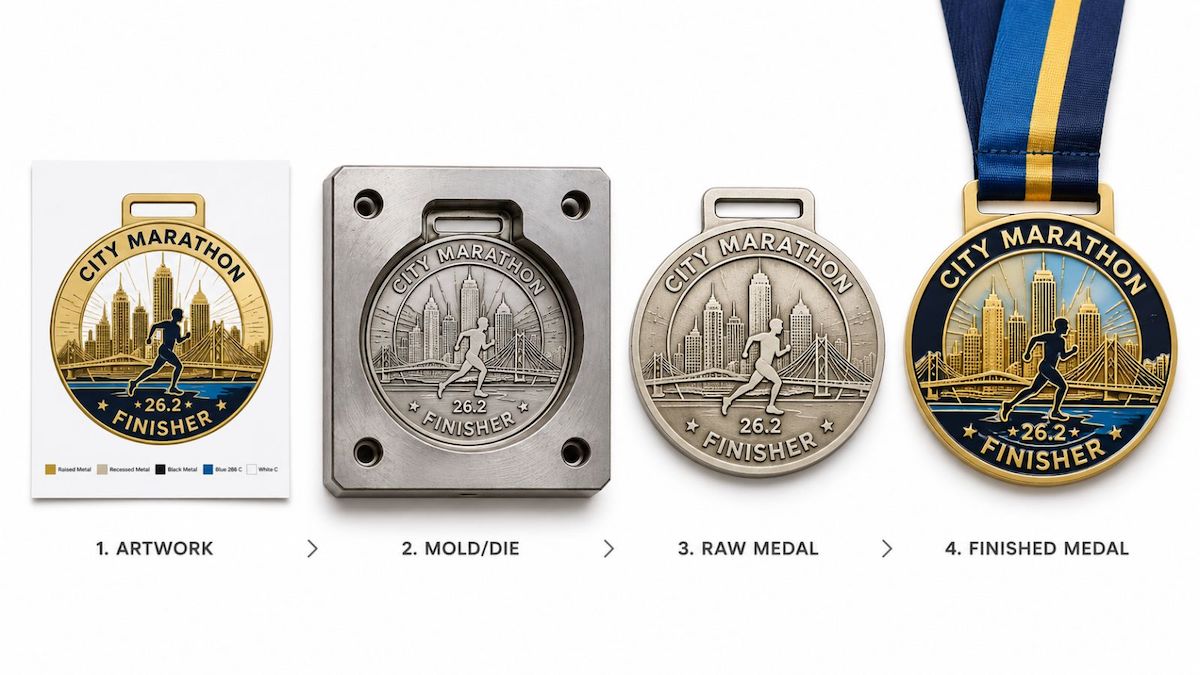
Step 5: Develop detailed artwork. Create production-ready vector files with clear specifications for raised/recessed areas, colors, and finishes.
Step 6: Request a 3D rendering. Review the design in three dimensions before committing to tooling.
Step 7: Approve a physical sample. Hold the medal in your hand. Check weight, texture, color accuracy, and overall quality.
Step 8: Confirm production timeline. Allow adequate lead time—typically 4–8 weeks from sample approval to delivery, depending on quantity and complexity.
Final Thoughts
A marathon medal is more than a piece of metal. It's a promise you make to every participant: that their effort mattered, that their experience was worth celebrating, and that they earned something worth keeping.
Design with that promise in mind, and your medal will become exactly what it should be—a keepsake that runners display with pride for years to come.
If you're planning your next race medal and want expert guidance on design, materials, and production, Morning Craft specializes in custom marathon medals that turn finish-line moments into lasting memories. From concept development to final production, we help race organizers create medals participants will never want to put down.
Next News: Custom Medal Design Guideline


.png)
.png)
.png)
.png)