
How Custom Medals Are Made: Complete Manufacturing Guide
Custom medals are made through a step-by-step manufacturing process that includes design artwork creation, mold making, die casting or stamping, polishing, plating, enamel coloring, and ribbon assembly — and at every stage of this custom medal production process, decisions about material, design complexity, surface finish, and accessories directly affect the final medal's quality, durability, unit cost, and lead time.
At Morning Craft, we've spent years helping clients bring their medal ideas to life. In this comprehensive guide, we'll walk you through the entire custom medal manufacturing process step by step, so you can make informed decisions and avoid costly mistakes.
Step 1: Turning Your Idea Into a Production-Ready Medal Design
Every custom medal begins with an idea. But translating that idea into a physical object requires careful planning and technical understanding.
What Information Does a Medal Manufacturer Need From the Customer?
Before production can begin, your manufacturer needs clear direction. This typically includes:
- A reference image, logo, sketch, or concept description
- The intended purpose of the medal (sports event, corporate award, commemorative piece, etc.)
- Desired size, shape, and approximate quantity
- Budget range and timeline expectations
- Any specific text, dates, or numbering requirements
The more detailed your brief, the more accurate the initial quote and the fewer revisions needed during the design phase.
Converting a Logo, Sketch, or Concept Into Medal Artwork
Most clients come to us with a logo file, a rough sketch, or even just a verbal description. Our design team converts these into production-ready vector artwork that accounts for the physical limitations of metal forming.
This is where many first-time buyers are surprised: what looks perfect on a screen doesn't always translate well into metal. Extremely thin lines, tiny text, and subtle gradients may not survive the casting or stamping process. A skilled medal designer knows how to adapt artwork so it reads clearly in three dimensions.
Choosing the Medal Size, Thickness, Shape, and Weight
Standard custom medals range from 50mm to 80mm in diameter, though we've produced pieces as small as 30mm and as large as 120mm. Thickness typically falls between 3mm and 6mm, depending on the level of 3D detail required.
Shape is another critical decision. Round medals are the most common and cost-effective, but custom shapes — stars, shields, hexagons, or entirely freeform silhouettes — are also possible. Keep in mind that unusual shapes may require additional tooling and can affect unit pricing.
Designing Raised, Recessed, and 3D Details
Medal surfaces can feature:
- Raised (relief) elements that stand above the background
- Recessed (engraved) areas that sit below the surface
- Full 3D sculpting with multiple depth levels for dramatic visual impact
The more depth variation your design includes, the more complex the mold becomes — which directly impacts cost and lead time.
Planning Text, Numbers, Dates, Logos, and Small Details
Text on medals must be sized appropriately. As a general rule, any text smaller than 1.5mm in height risks becoming illegible after plating. Logos with fine details may need to be simplified or enlarged to maintain clarity.
If your medal requires sequential numbering (common in marathon finisher medals), this must be planned into the design or handled as a post-production engraving step.
Why Some Artwork Looks Good Digitally but Does Not Work Well in Metal
Digital designs can feature infinite detail, gradients, and ultra-thin lines. Metal cannot. During die casting or stamping, metal flows into a mold under pressure. If a design element is too thin or too deep relative to its width, the metal won't fill properly, resulting in incomplete or weak details.
Deep Insight: How Medal Design Affects Manufacturing Cost Before Production Even Starts
Many buyers focus on unit price without realizing that design complexity is the single biggest cost driver. A simple flat medal with one level of relief might cost 1.50 per piece at volume,while a fully sculpted 3D medal with multiple depth levels,custom cutouts,and intricate detailing could cost 4–$6 or more. The design phase is where you have the most control over your final budget.
Step 2: Choosing the Right Metal for Custom Medals
Material selection is one of the most consequential decisions in custom medal production. It affects weight, detail resolution, durability, finish quality, and price.
Zinc Alloy vs. Iron vs. Brass vs. Copper
| Material | Best For | Detail Level | Weight | Relative Cost |
|---|---|---|---|---|
| Zinc Alloy | 3D medals, complex shapes | Excellent | Medium | Moderate |
| Iron (Stamped) | Flat or low-relief medals | Good | Heavy | Low |
| Brass | Premium finish, engraved details | Very Good | Heavy | Higher |
| Copper | Antique or vintage aesthetics | Good | Heavy | Higher |
When Is Zinc Alloy the Best Choice?
Zinc alloy is the go-to material for custom 3D medals, die-cast medals, and designs with complex shapes or multiple depth levels. It flows easily into molds, capturing fine details that other metals cannot replicate through stamping. If your medal features sculpted figures, layered backgrounds, or freeform shapes, zinc alloy is almost certainly your best option.
When Should You Choose Stamped Iron or Brass?
Stamped iron is ideal for flat or lightly textured medals produced in high volumes. It's the most cost-effective option for simple designs — think school participation medals or basic event finisher medals. Brass offers a premium feel and is often chosen for military-style medals, commemorative awards, and pieces where a gold-tone finish is desired without plating.
How Material Affects Weight, Detail, Durability, and Price
- Weight: Iron and brass are noticeably heavier than zinc alloy, which can be a positive (feels premium) or negative (uncomfortable for runners wearing medals around their necks).
- Detail: Zinc alloy captures the finest 3D detail. Stamped metals are limited to shallower relief.
- Durability: All four materials are durable when properly plated. However, zinc alloy is slightly softer and more prone to surface scratches if not handled carefully during finishing.
- Price: Stamped iron is the cheapest per unit. Zinc alloy sits in the middle. Brass and copper command premium pricing.
Choosing Materials for Specific Medal Types
- Sports medals & marathon medals: Zinc alloy for 3D designs; stamped iron for budget-friendly flat options
- Military-style medals: Brass or copper for traditional weight and appearance
- Commemorative awards: Brass or zinc alloy, depending on design complexity
Deep Insight: Don't Choose Medal Material Based Only on Price
A cheaper material that doesn't suit your design will result in poor detail, a flimsy feel, or a finish that doesn't hold up over time. Always match the material to the design intent. A $0.30 saving per unit means nothing if the final product doesn't represent your brand or event properly.
Step 3: Creating the Mold or Die
The mold is the heart of custom medal production. It is the tool that transfers your design into metal, and its quality determines the quality of every single medal produced.
How a Custom Medal Mold Is Made
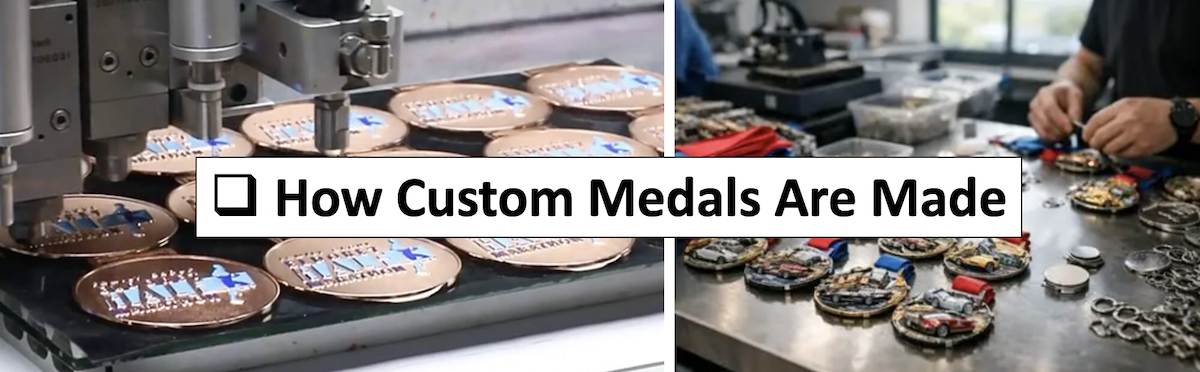
Once your artwork is finalized and approved, it is converted into a 3D model using CAD software. This digital model is then used to machine a steel mold (for die casting) or a hardened steel die (for stamping).
CNC Machining and Engraving the Mold
Computer-controlled CNC machines carve the medal design into the mold steel with extreme precision. For highly detailed or sculpted designs, this process can take several hours or even days. The depth, angle, and sharpness of every element in your design is physically carved into the mold cavity.
How the Mold Transfers Fine Details to the Medal
When molten zinc alloy is injected into the mold (or when a metal blank is pressed between stamping dies), every groove, ridge, and contour in the mold is replicated onto the medal surface. The sharper and more precise the mold, the sharper the final product.
Why Mold Quality Determines Consistency Across Hundreds or Thousands of Medals
A poorly made mold will produce inconsistent results — some medals will have crisp details while others appear soft or incomplete. A high-quality mold ensures that medal #1 and medal #5,000 look identical. This is especially important for large event orders where uniformity matters.
How Complex 3D Designs Increase Mold Difficulty
Multi-level 3D designs require molds with varying depths and angles. Undercuts (areas where the design curves back underneath itself) can make it impossible to release the medal from the mold without damage. In such cases, the design may need to be modified, or a multi-part mold may be required — both of which increase cost.
What Happens When a Design Has Undercuts or Complicated Cutouts?
Undercuts require side-action molds or sliding cores, which add complexity and cost. Complicated cutouts (open areas within the medal shape) require additional machining and can weaken the mold over time. Your manufacturer should flag these issues during the design review stage.
Deep Insight: Why the Mold Is One of the Most Important Investments in Custom Medal Production
The mold is a one-time cost, but it affects every single medal you produce. Investing in a high-quality mold pays dividends in consistency, detail sharpness, and long-term durability of the tool. At Morning Craft, we use premium mold steel and precision CNC machining to ensure our clients receive medals that meet the highest standards — order after order.
Step 4: Forming the Medal — Die Casting vs. Stamping
Once the mold or die is ready, it's time to form the actual medals. The two primary methods are die casting and stamping.
How Zinc Alloy Die Casting Works
In the die casting process, zinc alloy is heated to approximately 400°C until it becomes molten. The liquid metal is then injected under high pressure into the steel mold cavity. Within seconds, the metal cools and solidifies, taking on the exact shape and surface detail of the mold.
The medal is then ejected from the mold, and the cycle repeats. A single die casting machine can produce hundreds of medals per hour, making this method efficient for medium to large production runs.
How Die Casting Creates 3D Relief and Complex Shapes
Because the molten metal flows into every crevice of the mold under pressure, die casting is uniquely suited for producing medals with:
- Multiple levels of raised and recessed detail
- Fully sculpted 3D elements (figures, animals, objects)
- Complex outer shapes with cutouts
- Textured backgrounds (hammered, sandblast, leather-look, etc.)
Why Zinc Alloy Works Well for Intricate Custom Medals
Zinc alloy has a relatively low melting point and excellent fluidity, meaning it fills even the smallest details of a mold before solidifying. This makes it the preferred material for custom 3D medals, soft enamel medals, and hard enamel medals where fine detail is essential.
How Stamping Works (For Iron and Brass Medals)
Stamping uses a different approach. A flat sheet or blank of metal is placed between two hardened steel dies. A hydraulic press applies enormous force (often hundreds of tons), pressing the design into the metal. This creates a raised image on one side and a corresponding recess on the other.
Stamping is faster and cheaper than die casting but is limited to flatter designs with less depth variation. It's ideal for traditional round medals, military-style pieces, and high-volume orders where cost efficiency is paramount.
Step 5: Trimming, Deburring, and Polishing
After forming, medals are not yet ready for plating. They require several finishing steps to achieve a smooth, clean surface.
Removing Excess Metal After Casting or Stamping
Die-cast medals typically have a small amount of excess metal (called "flash") around the edges where the two halves of the mold meet. Stamped medals may have rough edges from the cutting process. This excess material must be removed through trimming or grinding.
Smoothing Medal Edges
Sharp or rough edges are not only unattractive but can be a safety hazard. All medal edges are smoothed and rounded during this stage.
Removing Casting Marks and Imperfections
Small surface imperfections — air bubbles, flow lines, or minor pits — are common in die-cast medals. These are addressed through careful hand-finishing or machine polishing before the medal moves to the plating stage.
Why Polishing Is Critical Before Plating
Plating is an extremely thin layer of metal (often just a few microns thick) applied to the medal surface. It does not fill in scratches, pits, or rough areas. If the surface beneath the plating is imperfect, those imperfections will be visible in the final product. Polishing ensures a mirror-smooth base for the plating to adhere to.
How Over-Polishing Can Reduce Fine Details
There's a balance to strike. Aggressive polishing can round off sharp edges and soften fine details that were carefully captured in the mold. Skilled finishing operators know exactly how much pressure and time to apply to achieve a smooth surface without sacrificing design integrity.
Deep Insight: Why Plating Cannot Hide Poor Surface Preparation
This is one of the most common misconceptions among first-time medal buyers. Plating is not a corrective step — it's a decorative and protective one. If you receive medals with visible scratches, bumps, or rough textures after plating, the issue originated in the polishing stage, not the plating stage. Always work with a manufacturer that prioritizes surface preparation.
Step 6: Adding the Ribbon and Medal Accessories
The final step in custom medal production is attaching the ribbon and any additional hardware. While it may seem like a minor detail, ribbon selection and attachment method significantly affect the medal's overall presentation and functionality.
How the Ribbon Attachment Is Designed
Ribbon attachment must be considered during the medal design phase, not after production. Common attachment methods include:
- Cast-in loop: A metal loop is integrated into the medal design during casting
- Soldered ring: A jump ring is soldered to the top of the medal after production
- Drilled hole: A hole is drilled through the medal for direct ribbon threading
- Clip or pin attachment: Used for breast-pin style medals
Each method has implications for the medal's design, structural integrity, and aesthetic.
Common Ribbon Styles and Materials
- Satin ribbon: Smooth, shiny finish; popular for sports and marathon medals
- Grosgrain ribbon: Ribbed texture; traditional for military and formal awards
- Polyester ribbon: Durable and colorfast; good for outdoor events
- Woven ribbon: Custom patterns woven directly into the fabric
Custom Ribbon Colors and Printing
Ribbons can be dyed to any Pantone color and can feature custom printing — event names, logos, dates, or sponsor branding. This is an excellent way to add value and branding to your medal without increasing the medal's production cost significantly.
Connecting Rings, Clips, and Other Hardware
The connecting hardware (jump rings, split rings, lobster clasps, or swivel clips) must be matched to the medal's weight and intended use. A heavy brass medal requires a stronger ring than a lightweight zinc alloy piece.
How to Choose the Right Ribbon for Different Medal Types
- Marathon medals: Wide satin ribbon (25–30mm) in event colors; comfortable for wearing around the neck
- Sports medals: Durable polyester ribbon; often in team or event colors
- School medals: Simple satin or grosgrain ribbon; budget-friendly
- Corporate awards: Premium grosgrain or woven ribbon; often with custom printing
Deep Insight: Why Ribbon Attachment Should Be Considered During Medal Design — Not After Production
We've seen clients request a ribbon loop after the mold has already been made, requiring costly mold modifications. By planning the attachment method at the design stage, you avoid delays and additional expenses. At Morning Craft, we always discuss ribbon and attachment options during the initial design consultation to ensure a seamless production process.
Final Thoughts
Custom medal manufacturing is a multi-step process where every decision — from design complexity to material selection, mold quality, forming method, surface finishing, and ribbon choice — directly impacts the final product's quality, cost, and lead time.
Understanding this process empowers you to make smarter decisions, communicate more effectively with your manufacturer, and ultimately receive medals that exceed expectations.
At Morning Craft, we guide our clients through every step of this journey. From initial concept to finished product, our team ensures that your custom medals are produced with precision, care, and attention to detail.
Ready to start your custom medal project? Contact us today for a free design consultation and quote.


.png)
.png)
.png)
.png)